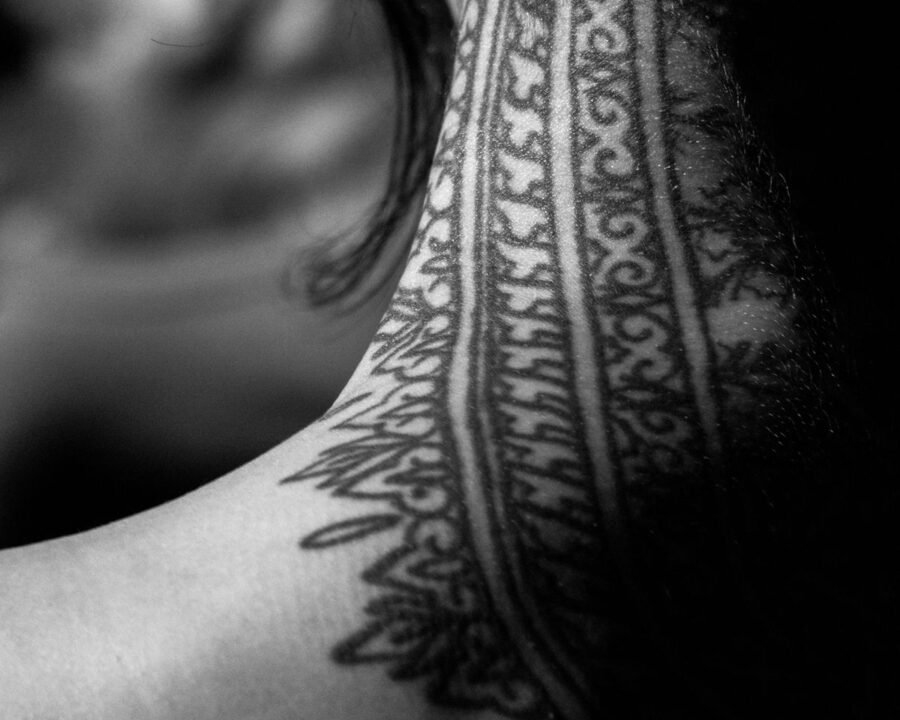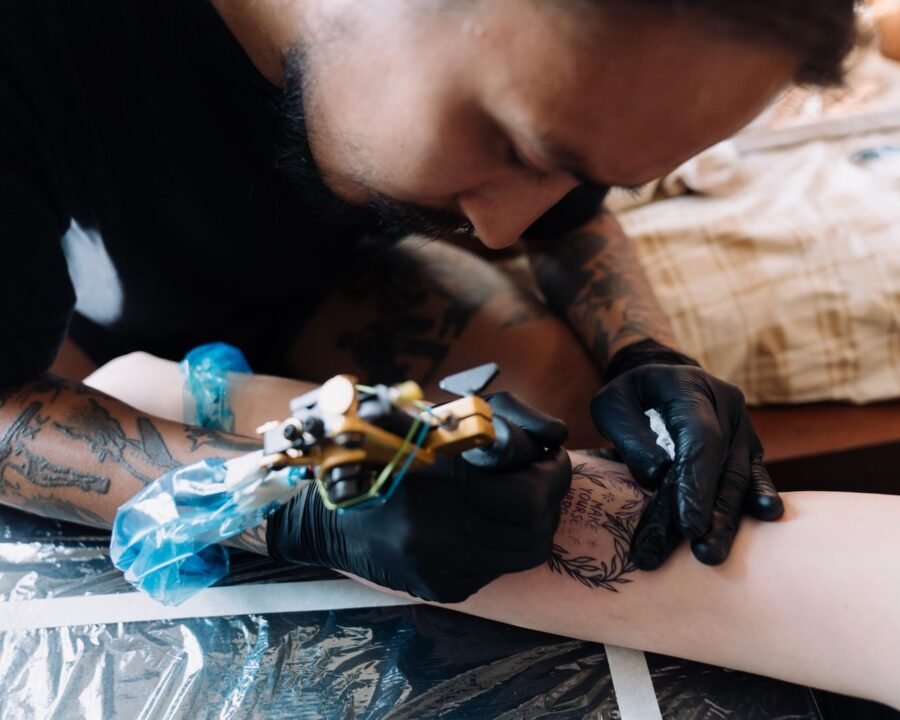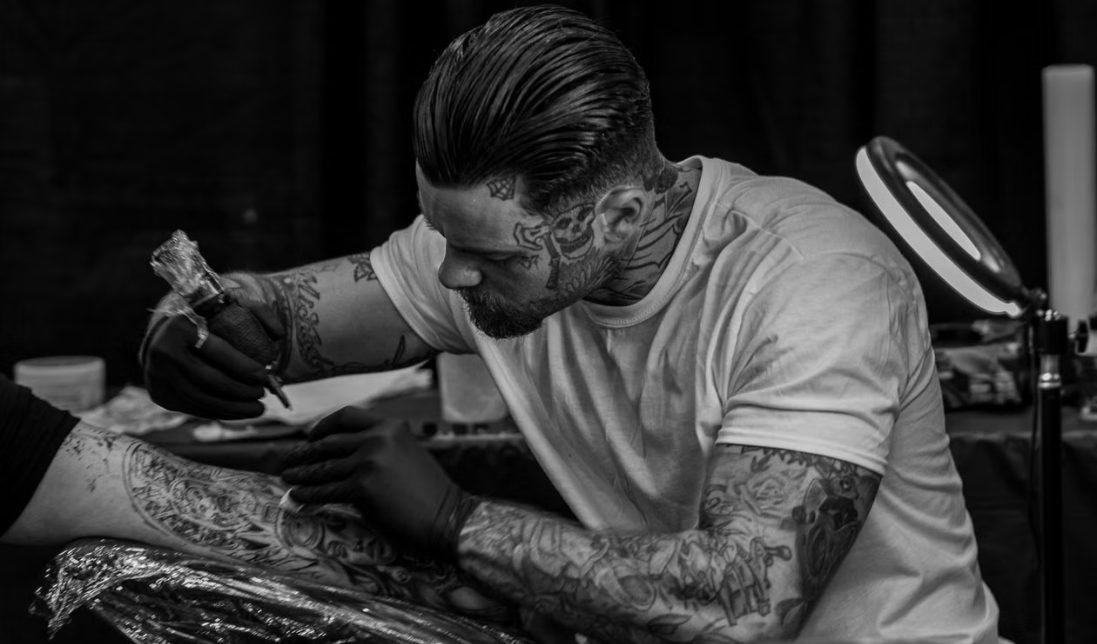
Here’s a quick answer if you’re short on time: the least painful tattoo spots are the outer upper arm, outer thigh, and calf — fleshy, low-nerve-density areas explained in full below. For the other end of the scale, and every area in between, see our full tattoo pain chart. And if you want the opposite list, see the most painful tattoo spots, ranked. At the other end, the neck is a High-band placement and a demanding first choice.
If pain is the deciding factor in where you put your next tattoo, the pattern holds up consistently across pain charts, artist experience, and the placement guides on this site: fleshy areas with thick muscle or fat and low nerve density hurt the least, while thin skin sitting close to bone, joints, or nerve-dense zones hurts the most. This guide ranks the most commonly chosen “low pain” spots from easiest to hardest, explains why each one lands where it does, and links out to full placement-specific guides where we’ve covered the details.
None of these rankings are exact for every person — individual pain tolerance, the artist’s technique, and how large or detailed the design is all shift where you personally land. But the underlying anatomy doesn’t change, and it’s the single biggest predictor of how a tattoo will feel.
Least Painful Tattoo Spots, Ranked
A note on the ratings below. This table uses pain bands rather than scores out of ten, because no study has produced per-body-part pain scores. Our full tattoo pain chart explains what the research actually found.
| Rank | Placement | Typical pain | Why |
|---|---|---|---|
| 1 | Outer upper arm / shoulder (deltoid) | Low | Thick muscle and fat cushion the needle; low nerve density. See our shoulder tattoo pain breakdown for how this changes near the shoulder blade or collarbone. |
| 2 | Outer thigh | Low | One of the fleshiest, most padded areas on the body with minimal nerve concentration. |
| 3 | Calf | Low–moderate | Thick muscle in most people; pain rises slightly nearer the shin or ankle bone. |
| 4 | Upper back / shoulder blade muscle (not the bone ridge) | Moderate | Padded by muscle across most of its surface, though the bony ridge and spine-side edge hurt more. |
| 5 | Forearm (outer) | Low–moderate | Moderate muscle coverage; more sensitive than the upper arm but still fairly tolerable. |
| 6 | Behind the ear | High | Small and quick, but thin skin close to bone pushes it into moderate territory. Full detail in our behind the ear tattoo guide. |
| 7 | Collarbone | High | Thin skin sitting almost directly on bone with little padding. See collarbone tattoo pain for why it varies along the bone. |
| 8 | Spine / lower back | High | Thin skin over vertebrae with a dense line of nerves; pain builds toward the tailbone. Full breakdown in spine tattoo pain. |
| 9 | Ribs | Very high | Bone flexes with every breath and there’s almost no muscle padding. |
| 10 | Hands and fingers | Very high | Thin skin pulled tight over bone and tendon with high nerve density and no fat layer. See hand tattoo healing time. |
The pain levels above use the same six bands as our tattoo pain chart, which is the reference every TattooPiece pain page defers to. We use bands rather than scores out of ten because no published research supports a pain number for individual body sites.
For a full body-by-body breakdown beyond this shortlist, our tattoo placement guide covers pain, healing time, and visibility together so you can weigh all three at once instead of pain alone.
For more on how skin’s nerve endings and thickness vary by layer, Cleveland Clinic’s overview of skin anatomy breaks down what this comes down to.
Why Fleshy Areas Hurt Less
Three anatomical factors drive almost all of the difference between a low-pain and a high-pain placement:
- Muscle and fat coverage. A thicker buffer between skin and bone absorbs and disperses the vibration of the needle, which is the single biggest reason the outer arm, thigh, and calf consistently rank as the most tolerable spots.
- Bone proximity. Where bone sits close to the surface — ribs, spine, collarbone, hands, ankles — the needle’s vibration transmits more directly, producing a sharper, more resonant sensation instead of a duller ache.
- Nerve density. Nerve endings aren’t distributed evenly across the body. Areas like the ribs, hands, and collarbone carry a higher concentration than the outer arm or thigh, independent of how much padding is underneath.
These three factors combine, which is why the placements that hurt the most — ribs, hands, spine — tend to score poorly on all three at once, while the easiest spots score well on all three.
If You’re Choosing a Placement Mainly for Pain
A few practical notes if low pain is your main priority rather than visibility or meaning:
- The outer upper arm and outer thigh are close to the best-case combination of low pain, easy healing, and simple aftercare — they’re also two of the more forgiving spots for a first tattoo.
- A design doesn’t have to be confined to one zone. If part of a piece needs to cross into a more painful area — a shoulder piece that wraps toward the shoulder blade, for example — ask your artist about sitting order and breaks for that section specifically.
- Pain tolerance is only half the decision. A low-pain spot that fades fast or is awkward to heal isn’t necessarily the better choice — our guide to small tattoo placement ideas that age well covers the longevity side of the same question.
- Whatever placement you land on, how you treat it in the first few weeks affects how the pain and healing experience actually plays out. Our full tattoo aftercare guide is worth reading before your appointment, not after.
FAQ
What is the single least painful place to get a tattoo?
The outer upper arm (deltoid) and outer thigh are the most consistently cited low-pain spots, thanks to thick muscle and fat coverage and relatively low nerve density. Both sit at the low end of every pain comparison, for the same anatomical reason.
Are pain rankings the same for everyone?
No. These rankings reflect averages based on anatomy — skin thickness, bone proximity, and nerve density — but individual pain tolerance, hydration, sleep, anxiety level, and the artist’s technique all shift where any one person actually lands within that range.
Does a low-pain placement also mean easier healing?
Often, but not always. The outer arm and thigh tend to be both low-pain and easy to heal. Some low-pain spots, though, like behind the ear, come with their own healing complications — in that case, constant contact from glasses, hair, and headphones — that have nothing to do with how much the tattoo hurt going in.
Low-Pain Spots That Are Still Awkward to Heal
Pain and healing difficulty are not the same measurement, and several placements score well on one and badly on the other. The calf is comfortable to sit through but rubs against socks, trousers, and bedding for weeks afterward. The outer thigh is among the least painful areas on the body and still spends every day pressed against a chair.
The outer upper arm and shoulder are the two that genuinely win on both counts: low pain during the session and very little friction while healing. That is the real reason they get recommended for a first tattoo, rather than pain alone. Our healing timeline covers what the first three weeks ask of you regardless of placement.
What are the least painful tattoo spots for a first tattoo?
The outer upper arm and shoulder. Both are low pain, both are easy to keep clean, and neither bends or rubs much while healing, which matters as much as the session itself.
Are there any completely painless tattoo spots?
No. Every placement involves needles repeatedly breaking the skin, so there is no painless option. The areas at the top of this list are better described as manageable than as pain-free.
Do low-pain spots still hurt for large tattoos?
Yes, because session length matters as much as placement. Several hours on the outer thigh will be harder to sit through than twenty minutes on the ribs. If you are planning something large, ask your artist about splitting it across sessions.
The Bottom Line
Fleshy areas with muscle between the needle and the bone are the least painful tattoo spots, which is why the outer upper arm, outer thigh, and calf lead every version of this list. Weigh healing difficulty alongside pain, because the two do not always point at the same placement.
This article provides general educational information about placement, pain, and healing. It does not replace personalized advice from your tattoo artist or a qualified healthcare professional.