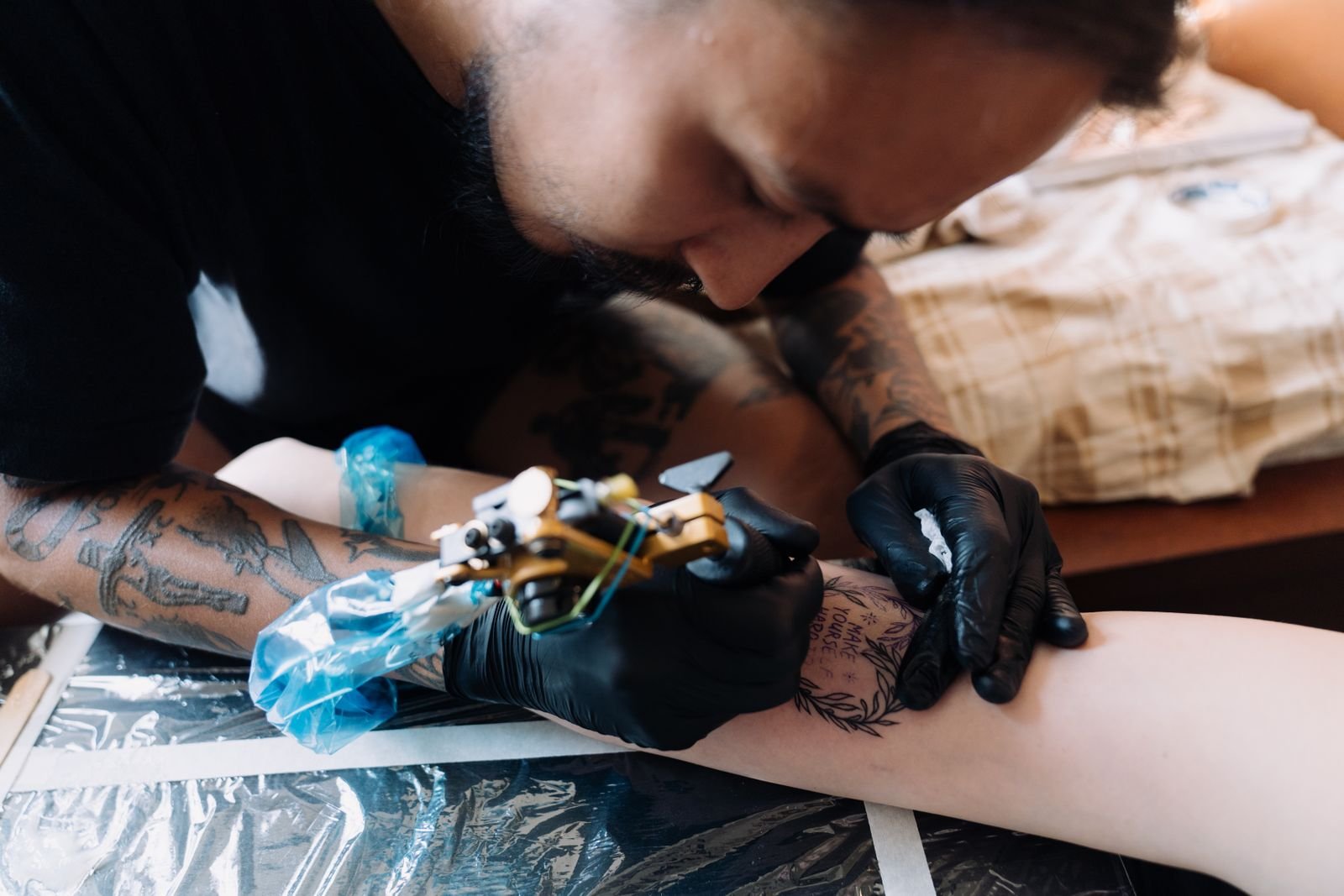
Forearm tattoo pain is genuinely two different experiences depending on which side you use. On our tattoo pain chart, the outer forearm sits in the low–moderate band and the inner forearm sits one band higher at moderate. Same limb, a few centimetres apart, and a noticeably different session.
That split is why the forearm is one of the most recommended placements for a first tattoo and also why some people are surprised by how much theirs stung. We do not give either side a score out of ten, because no published research supports pain numbers for individual body sites. What follows is what changes between the two surfaces, and how to use that when you plan a piece.
Inner vs Outer Forearm Tattoo Pain
The outer forearm is the side that faces the world when your arms hang down. The inner forearm is the pale, softer side that faces you when you turn your palm up. The difference in pain comes down to skin thickness, sun exposure, nerve density, and how close the bone runs to the surface.
| Comparison | Outer forearm | Inner forearm |
|---|---|---|
| Pain band | Low–moderate | Moderate |
| Skin | Thicker and more weathered from sun exposure | Thin, rarely sun-exposed, more sensitive |
| Nerve density | Relatively low | Higher, especially toward the wrist |
| Bone proximity | The ulna runs close to the surface along one edge | Mostly soft tissue, but the wrist end is bony |
| Typical sensation | A steady scratch, easy to talk through | Sharper and more ticklish, can feel electric near the wrist |
| Sitting still | Easy; the arm rests naturally palm-down | Harder; the palm-up position gets tiring |
| Good first tattoo? | One of the best options | Still very manageable, just a step up |
The practical takeaway: if pain is your main concern, put the design on the outer forearm. If you want the piece facing you, or you want the smoother canvas that fine line work sits well on, the inner forearm costs you roughly one band.
Why the Forearm Is an Easier Placement Than Most
Our chart assigns bands using four anatomical factors, and the forearm scores well on three of them. There is real muscle and tissue between the needle and the bone across most of the area, the skin on the outer side is thick, and nerve density is moderate rather than concentrated. Only the wrist end breaks the pattern.
Compare that with the placements at the top of the chart. On the ribs, bone sits directly under thin skin and the whole area moves as you breathe. The forearm has none of those problems: it rests still on an armrest, it does not move with your breathing, and there is something between the needle and your skeleton nearly everywhere. That is the entire reason it sits four to five bands lower.
Where Forearm Pain Changes Along the Arm
“Forearm” covers a lot of ground, and the sensation is not flat across it. Both bands describe the surface as a whole; within them, a few spots reliably stand out.
- Near the elbow — sharper on both sides as the bone gets closer to the surface. The elbow itself sits in the high band, several steps up from the forearm.
- Mid-forearm — the most comfortable stretch on either side, and where most people report the easiest sitting.
- Toward the wrist — noticeably sharper, particularly on the inner side, where tendons and nerves run close to the surface. The wrist is a moderate–high placement on the chart.
- The bony ridge along the outer edge — where the ulna runs near the surface, this narrow strip can feel sharper than the rest of the outer forearm.
If you are placing a long vertical design, this is worth discussing with your artist. Ending a piece an inch or two short of the wrist often removes the sharpest part of the session without changing how the tattoo reads.
How Forearm Tattoo Pain Compares to Other Placements
Placed against the rest of the chart, both forearm surfaces sit comfortably in the lower half of the range.
| Placement | Band | How it compares to the forearm |
|---|---|---|
| Outer upper arm | Low | One step easier than the outer forearm |
| Outer forearm | Low–moderate | — |
| Inner forearm | Moderate | One band above the outer forearm |
| Wrist | Moderate–high | A step up again, where the forearm ends |
| Collarbone | High | Two to three bands above the forearm |
| Ribs | Very high | The top band; four steps above the outer forearm |
For the full picture in both directions, see the ranked least painful tattoo spots and the most painful tattoo spots.
What Makes a Forearm Session Easier
The largest peer-reviewed survey of tattoo pain, Witkoś and Hartman-Petrycka (2020), surveyed 1,092 people and found body region did not significantly predict overall pain intensity — but session duration did. The same study found radiating pain was reported more often for upper-limb tattoos than lower-limb ones (83% versus 72%), which matches what many people describe on the inner forearm as a tingling that spreads toward the hand.
- Choose the outer forearm if pain is the deciding factor. It is a full band lower and the arm rests naturally palm-down for the whole session.
- Keep the first session shorter. Duration is the variable most strongly linked to reported pain, and it is the one you control.
- Stop short of the wrist. The last inch or two is where most of the sharpness lives on the inner side.
- Eat beforehand and go in rested. Standard advice, but it matters more toward the end of a long sitting than at the start.
- Support the arm properly. Inner forearm work means holding your palm up; ask for a rest or cushion rather than tensing the arm, which makes the skin harder to work on.
Is the Forearm a Good First Tattoo?
For most people, yes. It is one of the few placements that is genuinely comfortable, easy to keep still, simple to keep clean, and visible enough that you actually see the piece you paid for. The outer forearm in particular is among the most common recommendations artists make to first-timers.
The one thing worth thinking through is visibility rather than pain. A forearm tattoo is difficult to cover in short sleeves, so it is a placement decision as much as a pain decision. If you want something equally comfortable but easier to conceal, the outer upper arm sits one band lower and disappears under a t-shirt.
After the Session
Forearm tattoos are among the easier placements to heal, largely because the area does not rub against bedding the way torso placements do and does not stretch much in normal movement. The main irritants are sleeves catching a fresh tattoo and hand washing running over the wrist end.
This page covers the session itself. For everything that happens afterwards, our tattoo aftercare guide covers the full healing timeline, and the wrist tattoo healing guide is the closest match if your design runs down that far.
Frequently Asked Questions
Does the inner or outer forearm hurt more?
The inner forearm hurts more. On our tattoo pain chart the outer forearm sits in the low–moderate band and the inner forearm one step higher at moderate. The inner side has thinner, less sun-exposed skin and higher nerve density, particularly as you approach the wrist.
How bad is forearm tattoo pain overall?
Mild by comparison with most placements. Both forearm surfaces sit in the lower half of our six-band chart, several bands below bony areas like the ribs, sternum and collarbone. Most people describe it as a persistent scratching sensation rather than sharp pain.
Is a forearm tattoo a good choice for a first tattoo?
It is one of the best options. The outer forearm is comfortable, easy to hold still, straightforward to heal, and large enough for a meaningful design. The main consideration is visibility rather than pain, since it is hard to cover in short sleeves.
Which part of the forearm hurts the most?
The inner side closest to the wrist. Tendons and nerves run near the surface there, and the wrist itself sits in the moderate–high band. The mid-forearm is the most comfortable stretch on either surface.
Does a forearm tattoo hurt more than the upper arm?
Slightly. The outer upper arm sits in the low band, one step below the outer forearm and two below the inner forearm, because the deltoid and bicep carry more muscle bulk with no bone near the surface.
Why does my forearm tattoo feel like it is tingling toward my hand?
That is radiating pain, and it is common on the inner forearm. The 1,092-person survey cited above found radiating sensation was reported by 83% of people tattooed on an upper limb. It usually settles once the needle moves to a different part of the design.
The Bottom Line
Forearm tattoo pain is manageable on both sides, and the choice between them is a real one: outer forearm at low–moderate, inner forearm at moderate. Neither comes close to the bony placements at the top of the chart. Stop short of the wrist, keep the first sitting reasonable, and the forearm will be one of the more comfortable tattoos you sit through. See the full tattoo pain chart for how all 30 areas compare.