This tattoo pain chart ranks every major body area from low to very high, based on where the needle sits relative to bone, nerve endings, and the amount of muscle or fat underneath. Broadly: fleshy areas with muscle between skin and bone hurt least, and anywhere the needle passes over bone with thin skin above it hurts most.
One thing worth saying before the chart. Pain is subjective, and no two people report the same placement the same way. Treat this as a comparison between areas, not a prediction of what you personally will feel.
Tattoo Pain Chart: Every Body Area, Ranked
| Body area | Typical pain | Why it feels that way | More detail |
|---|---|---|---|
| Outer upper arm | Low | Thick muscle over bone with relatively few nerve endings | — |
| Shoulder | Low | A rounded cap of muscle with no bone near the surface | Guide |
| Outer thigh | Low | Heavy muscle and fat cushioning the needle | — |
| Bicep | Low | Muscle bulk absorbs most of the vibration | — |
| Inner bicep | Moderate–high | Thin skin and dense nerve supply on the underside, with no muscle bulk shielding it | — |
| Buttocks | Low–moderate | Among the most cushioned areas on the body | — |
| Calf | Low–moderate | Muscular, though it thins as it approaches the shin | — |
| Outer forearm | Low–moderate | Muscle covers most of it, but bone sits close in places | Pain guide |
| Upper back | Moderate | Comfortable across the shoulder blades, sharper near the spine | — |
| Inner forearm | Moderate | Thinner, rarely sun-exposed skin with more nerve endings | Pain guide |
| Lower back | Moderate | Fleshy either side of the spine, sharper directly over it | — |
| Hip | Moderate | Fine over soft tissue, harder across the hip bone | — |
| Stomach | Moderate–high | Soft but sensitive, and it moves with every breath | — |
| Upper chest | Moderate–high | Manageable on muscle, sharp as it nears the collarbone | — |
| Wrist | Moderate–high | Thin skin, bone close to the surface, tendons underneath | Guide |
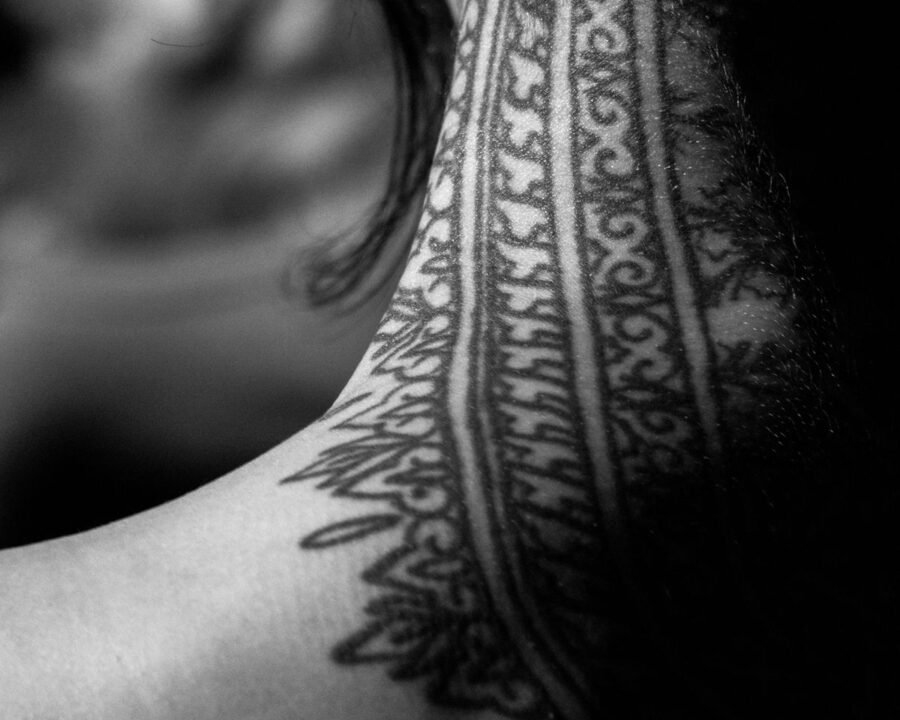
| Neck | High | Thin skin over vertebrae with a dense nerve supply | Pain guide |
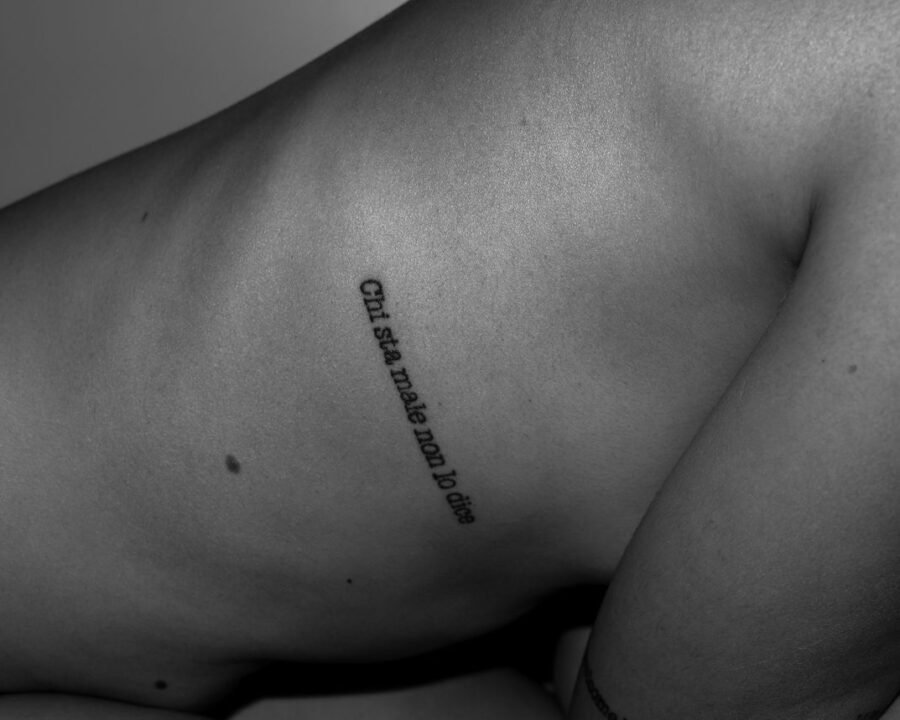
| Collarbone | High | Bone directly beneath thin skin with almost no cushioning | Guide |
| Behind the ear | High | Thin skin over bone, and the vibration carries through the skull | Guide |
| Ribs | Very high | Bone under a thin layer of skin, and the area moves as you breathe | Rib pain guide |
| Sternum | Very high | Bone straight down the center with almost no tissue over it | Sternum guide |
| Spine | High | Vertebrae sit directly under the needle along the whole line | Guide |
| Elbow and elbow ditch | High | Bone on the outside, dense nerve endings in the crease | Guide |
| Knee and behind the knee | High | Bone across the cap, very thin sensitive skin behind it | Guide |
| Inner thigh | High | Thin skin with a high concentration of nerve endings | — |
| Ankle | High | Bone on nearly every side with barely any padding | — |
| Feet | High | Thin skin, bone close throughout, and dense nerve endings | Guide |
| Hands and fingers | Very high | Dense nerve endings, bone near the surface, constant movement | Guide |
| Head and scalp | High | Bone directly under thin skin; the sound and vibration are the hard part | — |
| Armpit | Very high | Thin skin, a major nerve cluster, and very little tissue | — |
| Face | Very high | Thin skin over bone with a dense nerve supply throughout | — |
Why This Chart Uses Bands Instead of Numbers
Most tattoo pain charts assign each body area a score out of ten. Those numbers look precise, but they are not measurements. The largest peer-reviewed survey of tattoo pain we could find — Witkoś and Hartman-Petrycka (2020), published in the International Journal of Environmental Research and Public Health, which surveyed 1,092 people using a standard 0–10 numerical rating scale — did not produce a ranking of body sites at all. It found that body region significantly predicted radiating pain, meaning pain spreading beyond the area being tattooed (reported by 83% of people tattooed on an upper limb versus 72% on a lower limb), but not overall pain intensity during the procedure.
That does not make the anatomy meaningless. Bone proximity, nerve density, and skin thickness are real differences, and the ordering below matches what artists and clients consistently report. What it does mean is that a chart calling the ribs exactly a 7 is claiming a precision nobody has actually measured. Bands are less satisfying to look at and more honest about what is known, so this chart uses them.
How We Assign Pain Bands
Each area in the chart is placed in one of six bands using four anatomical criteria: how close bone sits to the surface, nerve ending density, skin thickness, and how much muscle or fat cushions the needle. Those four factors are described in detail in the next section, and they are applied consistently — an area is not moved up or down because it is fashionable or because it photographs well.
What the bands actually mean. A band describes how an area typically compares to others, not how much it will hurt you specifically:
| Band | What people typically report | Areas in this band |
|---|---|---|
| Low | A dull scratch or vibration; most people can sit for long sessions without breaks | 4 |
| Low–moderate | Noticeable but easy to talk through; discomfort builds slowly | 3 |
| Moderate | Clearly uncomfortable in places, manageable with normal breaks | 4 |
| Moderate–high | Sharp in spots, usually where the needle nears bone or a nerve path | 4 |
| High | Sharp and hard to ignore; most people need breaks and plan shorter sessions | 10 |
| Very high | Intense throughout; commonly split across multiple shorter sittings | 5 |
What the evidence supports. The anatomical factors behind these bands are well established, but the peer-reviewed evidence on tattoo pain is thinner than most charts imply. The Witkoś and Hartman-Petrycka survey cited above found no significant relationship between body region and overall pain intensity, while it did find that session duration significantly predicted how much pain people reported. That is why this page treats how long you sit as being as important as where you sit — that part is an empirical finding, not an opinion.
This chart is our reference page. Where a TattooPiece article about a single placement gives a pain level, it uses the band assigned here. When a deeper single-area review changes our view, we update this chart first and then the article — not the other way around. Ribs, sternum, and hands were moved from High to Very high on 20 August 2026 for exactly that reason.
Limitations of This Chart
This chart is an editorial ranking built from anatomy and reported experience. It is not a measurement, and four limits are worth stating plainly:
- The bands are qualitative, not measured. No one has published pain scores per body site from a controlled study. Any chart claiming a precise number for each area — including the 1–10 scores you will see elsewhere — is presenting judgement as data.
- Individual variation is large. Pain tolerance, sleep, anxiety, and where you are in a session all shift the experience. Two people can rate the same placement several bands apart.
- Areas are broad. “Shoulder” and “ribs” each cover several inches of very different tissue. Pain often changes within a single listed area, which is why the chart links to deeper breakdowns where they exist.
- We have no first-hand pain data of our own. These bands reflect anatomy plus widely reported experience, not a TattooPiece survey. If that changes, this section will say so.
Last verified 20 August 2026. We review this chart every six months and whenever a single-placement guide changes our assessment of an area. Next scheduled review: February 2027.
What Actually Makes a Spot Hurt
Four things explain almost every row in the chart above.
- How close the bone is. Where there is little tissue between skin and bone, the vibration transfers straight into it. Ribs, sternum, collarbone, ankle, and shin all work this way.
- Nerve ending density. Hands, fingers, feet, the inner thigh, and the armpit carry far more nerve endings per square inch than the outer arm or thigh.
- Skin thickness. Thin skin puts the needle closer to everything underneath it. The inner forearm and the area behind the knee are both thinner than they look.
- Muscle and fat cushioning. This is the reason the outer thigh and the outer upper arm sit at the bottom of the chart. Padding absorbs vibration before it reaches anything sensitive.
The Least Painful Areas
The outer upper arm, shoulder, outer thigh, and bicep are the four places most often recommended for a first tattoo, and the chart reflects why: all four are muscular, none has bone close to the surface, and none of them bends constantly while healing. If pain is your main concern, our ranked list of the least painful places goes into more detail on each.
The Most Painful Areas
The armpit and face sit at the top, followed by a tight cluster of high-pain areas: ribs, sternum, spine, elbow, knee, ankle, feet, hands, and behind the ear. Almost all of them share the same two problems, which is thin skin and bone immediately underneath. We rank every one of these — and how to sit a session on them — in our guide to the most painful tattoo spots.
None of this means these placements are a bad idea. Plenty of people sit through rib and hand work without difficulty. It does mean a shorter first session and a simpler design are sensible if you are starting somewhere on this list, and that healing is usually harder too. Our placement guide weighs pain against visibility, aging, and healing difficulty if you are still deciding.
Placement changes your bill as well as your pain tolerance. Among the 41 studios whose published rates we checked, at least one charges a higher minimum for hands, neck, and face specifically — $60 for a standard spot versus $100 for those three. If you are weighing a high-pain area, it is worth checking what a piece that size and placement typically costs before you book.
What Changes Pain Beyond Placement
Placement sets the baseline. These shift it in either direction.
- Session length. Almost everyone reports the last hour as the hardest regardless of where the tattoo is. Endurance fades before the area becomes objectively more painful.
- Line work versus shading versus color packing. Solid packing over the same patch of skin is usually reported as more punishing than clean line work.
- Sleep and food. Arriving tired or on an empty stomach reliably makes the session harder to sit through.
- Alcohol. Worth avoiding beforehand for reasons beyond pain, covered in our guide to drinking before a tattoo.
- Your artist. Hand speed, needle grouping, and machine setup all vary, and two artists can produce noticeably different experiences on the same body part.
Turning up prepared genuinely helps. Our appointment preparation guide covers the practical version of all of this.
Does the Needle Touch Bone?
No. A tattoo needle penetrates roughly one to two millimeters, depositing ink in the dermis, the layer just beneath the surface. It does not reach bone anywhere on the body, including the places where bone feels closest.
What you feel over the ribs, sternum, or shin is vibration transferring into bone through a very thin layer of tissue, plus nerve endings sitting closer to the needle than they would elsewhere. The sensation is real, but nothing is being struck.
Frequently Asked Questions
What pain level is a tattoo?
Most people describe it as a persistent hot scratching or a sustained stinging rather than a sharp pain, and most describe it as very manageable in low-pain areas. The intensity depends far more on placement than on tattooing itself, which is why a chart is more useful than a single number.
What are the most painful places to get a tattoo?
The armpit and face are usually reported as the worst, followed by the ribs, sternum, spine, elbow ditch, behind the knee, ankles, feet, and hands. They all share thin skin with bone or dense nerve endings directly underneath.
Does a tattoo needle hit a bone?
No. The needle goes about one to two millimeters deep, into the dermis. Over bony areas you are feeling vibration carried into the bone through thin tissue, not contact with the bone itself.
Where does a tattoo hurt the least?
The outer upper arm, shoulder, outer thigh, and bicep are consistently the most manageable. All four have muscle between the needle and any bone, and none of them bends constantly while healing.
Does tattoo pain get worse the longer you sit?
For most people, yes, though it is endurance rather than the area becoming more sensitive. Long sessions are usually hardest in the final stretch. Booking a shorter first session on a high-pain area is a reasonable way to find out how you cope.
Do numbing creams work?
Topical lidocaine products do reduce sensation for a limited window, but they can change how the skin takes ink and not every artist will work over them. Our full guide to tattoo numbing cream covers the active ingredients and safety limits. Ask your artist before booking rather than turning up having applied something, because it affects their work as much as your comfort.
The Bottom Line
Bone proximity and nerve density explain nearly all of it. Muscle and fat between the needle and your skeleton is what makes a placement comfortable, and the absence of it is what makes ribs, hands, and feet hard. Use the chart to compare areas, then talk to your artist about session length, because how long you sit will shape the experience as much as where you sit.