Neck tattoo pain sits in the High band on the TattooPiece tattoo pain chart. That means most people describe it as sharp and hard to ignore, need breaks during the session, and plan shorter sittings than they would for an arm or thigh piece. It is not the most painful placement on the body — ribs, sternum, hands and the face all sit a band above it — but it is firmly in the territory where the tattoo is something you have to actively sit through rather than talk through.
This guide explains what neck tattoo pain actually feels like, why the neck lands where it does in our banding, how it compares with the placements nearest to it, and what genuinely changes how hard the session is. We do not assign a number out of ten to any placement, and we explain why below.
Where the neck sits on the TattooPiece pain chart
Our chart places the neck in the High band, described there as: sharp and hard to ignore; most people need breaks and plan shorter sessions. The reasoning we record for the neck row is thin skin over vertebrae with a dense nerve supply.
Nothing on this page overrides that band. If you have read our most painful tattoo spots roundup or our guide to the least painful places to get a tattoo, the neck should read the same way in all three places — High, above the middle of the body but below the small group of placements we band as Very high.
What neck tattoo pain feels like
The neck is not one uniform surface. Skin thickness, how close the bone is, and how much the area moves all change across a few centimetres, and people who have been tattooed in more than one spot on the neck usually describe those spots differently. The whole area still belongs to the High band; the sub-zones below explain the variation inside it rather than splitting it into separate bands.
Back of the neck and nape
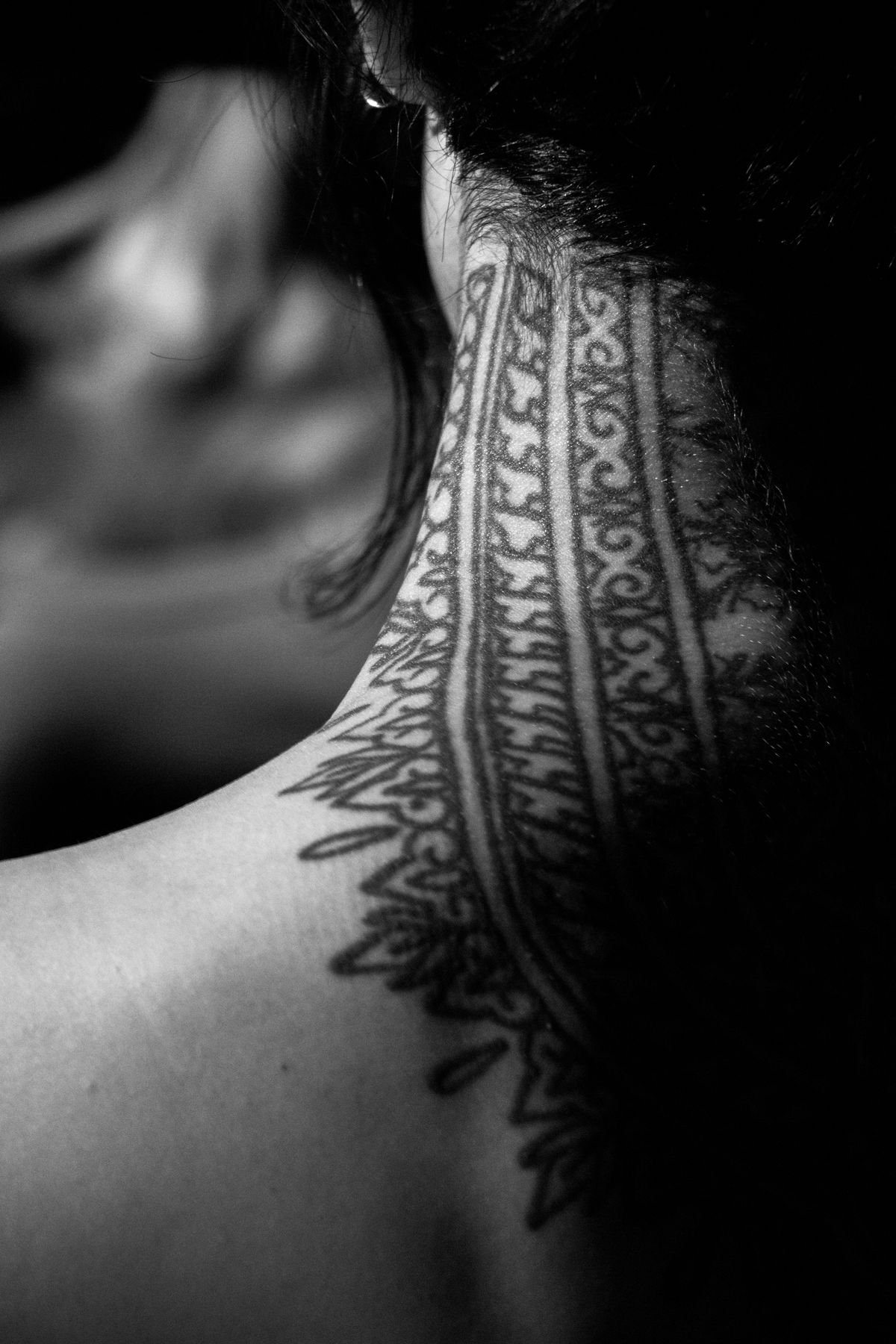
The nape is the part of the neck people most often start with. The skin sits directly over the cervical vertebrae, and the bony ridge running down the centre is where the sensation changes from a hot scratch to something sharper. Work either side of that ridge, over the muscle, is usually the most tolerable neck work there is. Line work straight down the centre is not.
Side of the neck
The side of the neck is soft, thin and highly mobile. People commonly report a stinging, buzzing quality here rather than a bony one, plus an odd secondary sensation from having a machine running that close to the ear. Being unable to turn your head freely for the length of the session is a real part of the discomfort, and it is the part most people underestimate.
Front of the throat
The throat is the hardest part of the neck to sit for. The skin is thin, there is very little padding, and swallowing, breathing and talking all move the surface being worked on. Many artists treat throat work as its own conversation and will limit how long they run it in one sitting. If you are choosing a first neck placement, this is not the one to start with.
Neck vs collarbone vs behind the ear vs sternum vs spine
These are the placements people weigh against the neck most often, because they sit in the same region of the body and share the same underlying problem: thin skin close to bone. Four of the five are in the same band. The table below uses the bands exactly as they appear on the pain chart.
| Placement | Band | What tends to drive the pain | Session note |
|---|---|---|---|
| Neck | High | Thin skin over vertebrae with a dense nerve supply | Short sittings; head position is limiting |
| Collarbone | High | Bone sitting directly under thin skin along its whole length | Sharp over the bone, easier just off it |
| Behind the ear | High | Very thin skin over the mastoid bone, close to the ear | Usually small pieces, so sessions are short |
| Sternum | Very high | Bone with almost no padding, plus breathing movement | Commonly split across sittings |
| Spine | High | Needle passing directly over the vertebral ridge | Long pieces mean long, broken-up sessions |
The practical takeaway: if you have sat through collarbone or behind-the-ear work, the neck will feel familiar in kind. If your only reference point is the sternum, expect the neck to be more manageable, not less.
Why we band the neck as High and not Very high
Three things keep the neck in the High band rather than the one above it. Each is an editorial judgement based on anatomy and on what people consistently report, not a measured score.
- Not all of it is bony. Unlike the sternum or the ribs, large parts of the neck sit over muscle rather than directly on bone, and those parts are noticeably easier.
- The pieces are usually smaller. Neck work tends to be compact by design, so the total time under the needle is shorter than a rib panel or a spine piece — and time under the needle is one of the few things with real evidence behind it.
- Reports are less uniform. Very high placements produce near-universal descriptions of intense pain throughout. Neck reports vary a lot more depending on the exact spot, which is the pattern our High band is meant to capture.
Why we do not give the neck a score out of ten
You will see the neck given a 7, an 8 or a 9 out of ten across the web, and those numbers are invented. Nobody has measured neck tattoo pain on a calibrated scale and published the result. The best available research points the other way: in a study of 1,092 tattooed people published in the International Journal of Environmental Research and Public Health, body region did not significantly predict overall pain intensity, while session duration did (B = 0.35, 95% CI 0.27–0.43, p = 0.001).
Bands are the honest response to that. They tell you what to plan for without pretending to a precision that does not exist. A number implies a measurement; a band states a judgement and shows its reasoning.
What actually changes how much a neck tattoo hurts
Most of the variables people worry about matter less than they think. These are the ones worth planning around.
- How long you sit. The single variable with published evidence behind it. A 90-minute neck session and a four-hour neck session are not the same experience, and splitting the work is a legitimate request.
- Exactly where on the neck. Side, nape and throat are genuinely different to sit for, as described above.
- Line work versus shading. Repeated passes over the same bony line are what most people name as the worst part, not solid fill over muscle.
- Head position. Holding your head turned or tilted for an hour creates its own ache that has nothing to do with the needle. Ask for position breaks specifically.
- Sleep and food. Turning up tired or unfed makes any placement harder to sit for. Our first tattoo tips cover the basics.
Planning a neck session
Because the neck is a High-band placement, plan for a shorter booking than you would for an arm or thigh piece of the same size. Ask your artist upfront how long they expect to run and whether they would rather split it. Agree a break signal before they start — on the neck you cannot easily speak or move your head mid-pass, so a hand signal is more practical than saying something.
Numbing products are a common question for this placement. They are worth discussing with your artist rather than applying on your own, since some affect how the skin takes ink; our guide to tattoo numbing cream covers what they do and do not do.
A note on healing, briefly
This is a pain page, not an aftercare page, but one point belongs here because it affects how the days after feel: the neck moves constantly and rubs against collars, hair and pillows, so soreness lingers more than the session length alone would suggest. Full instructions live in our tattoo aftercare guide.
Frequently asked questions about neck tattoo pain
How bad is neck tattoo pain compared with other placements?
The neck sits in the High band on our pain chart: sharp and hard to ignore, with most people needing breaks and planning shorter sessions. It is harder to sit for than the forearm, upper arm or thigh, and easier than the ribs, sternum, hands or face, which we band Very high.
Which part of the neck hurts the most?
Most people name the front of the throat and the bony centre line at the back of the neck as the hardest parts. Work to either side of that centre line, over muscle rather than directly on the vertebrae, is generally the most tolerable neck work.
Does a neck tattoo hurt more than a collarbone tattoo?
Both are in the High band, so we do not rank one above the other. They feel different: the collarbone is sharp along the bone and easier just off it, while the neck varies by sub-zone and adds the strain of holding your head still.
Is the neck a bad choice for a first tattoo?
It is a demanding first placement, and visibility is a separate consideration from pain. If you want to know how you handle being tattooed before committing, a Low or Low–moderate placement such as the outer forearm or outer upper arm gives you that information first.
How long does a neck tattoo session usually take?
It depends entirely on the design, but neck pieces are typically compact, and artists often keep sittings shorter here than for a comparable piece elsewhere. Ask your artist for their estimate and whether they would prefer to split the work before you book.
Why does TattooPiece not rate neck tattoo pain out of ten?
Because no one has measured it. The published research we rely on found that body region did not significantly predict overall pain intensity, while session duration did. Bands describe what to expect without inventing a precision that the evidence does not support.
Methodology and verification
The band on this page is taken directly from the TattooPiece tattoo pain chart and matches it exactly. Band assignments are editorial judgements built from anatomy and from patterns in how people describe being tattooed — they are not measured data, and we do not present them as such. The anatomical descriptions of the neck’s sub-zones on this page are our own editorial reasoning, not findings drawn from the cited study.
Research cited: Witkoś J, Hartman-Petrycka M. “Gender Differences in Subjective Pain Perception during and after Tattooing.” International Journal of Environmental Research and Public Health 2020;17(24):9466. doi:10.3390/ijerph17249466. N = 1,092.
Last verified 20 August 2026 by the TattooPiece Editorial Team.