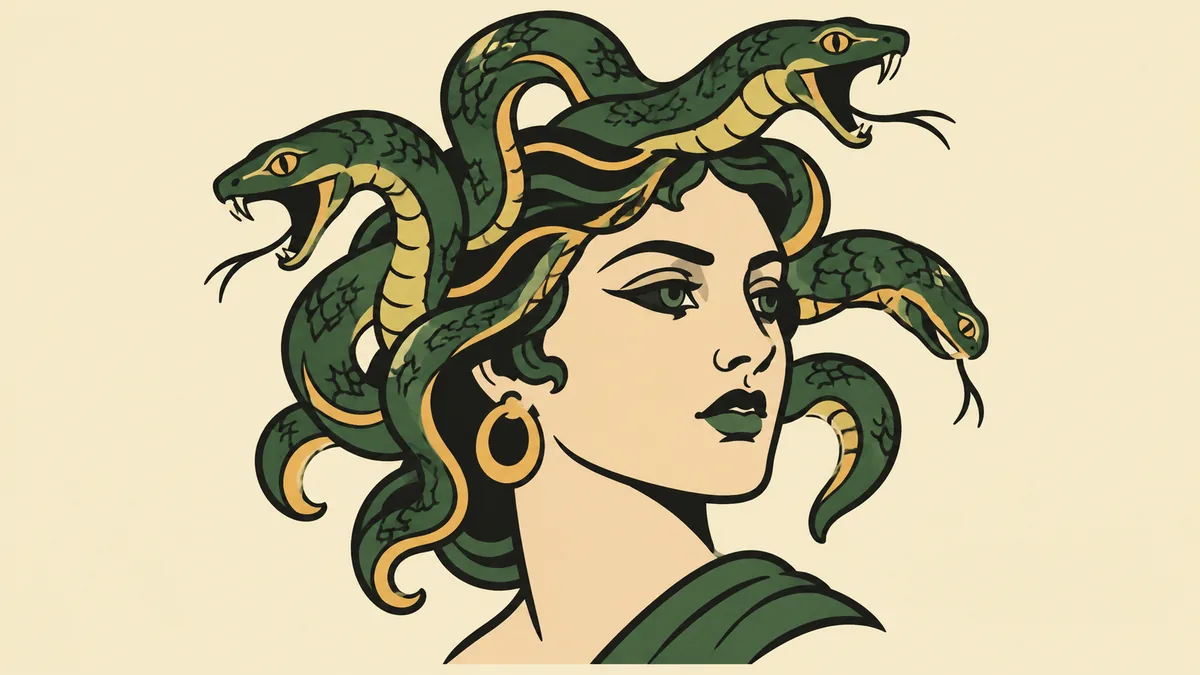
The medusa tattoo meaning has shifted more than almost any other design in modern tattooing. For most of the last two thousand years she was shorthand for a monster. Today she is one of the most requested pieces in studios worldwide, and the people asking for her usually mean something close to the opposite.
This guide covers where the symbolism comes from, what it signals now, how the design behaves as a tattoo, and the practical questions worth settling before you book.
What a Medusa tattoo means today
Three readings dominate, and they overlap more than they compete.
- Reclaimed strength after harm. This is the dominant modern reading. In Ovid’s telling, Medusa is assaulted in Athena’s temple and then punished for it — transformed, exiled, eventually hunted. Survivors have taken her up as a symbol of surviving something that was never their fault, and of the anger that comes with it. If you see a Medusa tattoo on someone under forty, this is statistically the likeliest reason.
- Protection. Long before that, her face was a gorgoneion — carved onto shields, doorways and armour to turn danger away. The logic was simple: put the most frightening face you can imagine on the outside, and threats look elsewhere.
- Refusing to be looked at passively. Medusa is the rare figure in myth whose power is her gaze. A tattoo of her stares back. That reads differently on a forearm facing outward than on a thigh only you see, and people choose placement accordingly.
None of these are mutually exclusive, and no artist worth booking will ask you to justify which one applies. But knowing which reading you are after does change the design — a protective gorgoneion and a grieving Medusa look nothing alike.
The myth behind the Medusa tattoo meaning
The version most people know comes from Ovid’s Metamorphoses, written around 8 CE — roughly seven hundred years after the earliest Greek accounts. In Hesiod she is simply one of three Gorgon sisters, born monstrous. Ovid is the one who makes her mortal, beautiful, and wronged.
That gap matters, because the modern medusa tattoo meaning descends almost entirely from Ovid’s version rather than the older one. When people say the symbolism is “recent,” they are half right: the reclaiming is recent, but the raw material has been sitting in the story for two millennia.
The other detail that shapes the tattoo: after her death, her head keeps working. Perseus uses it as a weapon, and Athena eventually mounts it on her own shield. Even decapitated, she protects. Artists lean on this when a client wants the piece to read as a guardian rather than a warning.
How Medusa translates into different tattoo styles
She is a demanding subject. The hair alone is a dozen small subjects that all have to agree with each other.
- Black and grey realism. The most common choice, and the most punishing. Realism lives on smooth gradients, and gradients are the first thing to go as a tattoo ages. Budget for size — a realistic Medusa under about six inches will lose the eyes within a decade.
- Fine line. Elegant and increasingly popular, but the snakes are the problem: thin lines packed closely together will spread into each other over fifteen years. Good fine-line artists solve this by drawing fewer, larger snakes.
- Neo-traditional. Arguably the best structural fit. Bold outlines hold the snakes apart permanently, and the style’s appetite for ornament suits a subject that is essentially a portrait wearing a crown of moving parts. See our neo-traditional style guide for how it ages.
- Blackwork. Strong for the protective, gorgoneion reading. Solid black holds its shape better than any other approach, though it commits you — cover-ups over heavy blackwork are limited.
Placement, and why it changes the piece
Medusa is usually a medium-to-large piece, because the face has to carry expression and the snakes need room to read as separate animals.
- Outer thigh and upper arm. The two most common. Both offer a large, relatively flat canvas, both age well, and both sit in the low-to-moderate pain range. Start with our tattoo pain chart if that is a factor.
- Forearm. Popular for the confrontational reading, since the piece faces outward at other people. Bear in mind it is also the placement you will explain most often to strangers.
- Back and ribs. Best for large, detailed work, and private by default. Ribs hurt considerably more — see rib tattoo pain before committing to a long session there.
- Sternum. Naturally symmetrical, which suits a frontal, staring composition. Also one of the more demanding spots to sit through.
Questions worth settling before you book
- Frontal or three-quarter? A frontal face stares at the viewer and reads as confrontation or protection. A three-quarter or downcast face reads as grief. This single decision changes the meaning more than any other.
- How many snakes? Fewer, larger snakes age dramatically better than a dense nest. Ask your artist to show you healed photos of their own work, not fresh ones.
- Colour or not? Green snakes are the obvious choice and the one most likely to date. Black and grey with a single colour accent tends to hold up better.
- Does your artist actually draw faces? Portrait work is a specialisation. An excellent traditional artist may not be the right person for a realistic face, and a good one will tell you so.
A note on the reclaimed reading
If you are getting this piece because of what it means to survivors, you do not owe anyone an explanation — not your artist, not the person who asks about it at work. Artists who tattoo Medusa regularly are generally aware of the symbolism and will not press. If one does press, that is information about the artist.
It is also worth knowing that you will be asked about it, occasionally by people with no sense of what they are asking. Placement is the main lever you have over how often that happens.
The short version
The medusa tattoo meaning today is mostly about surviving something and refusing to be quiet about it, layered over a much older use as a protective charm. As a design she is demanding — give her size, give her room, and pick an artist who can draw a face. Done properly she is one of the few pieces that gets more striking as it settles.