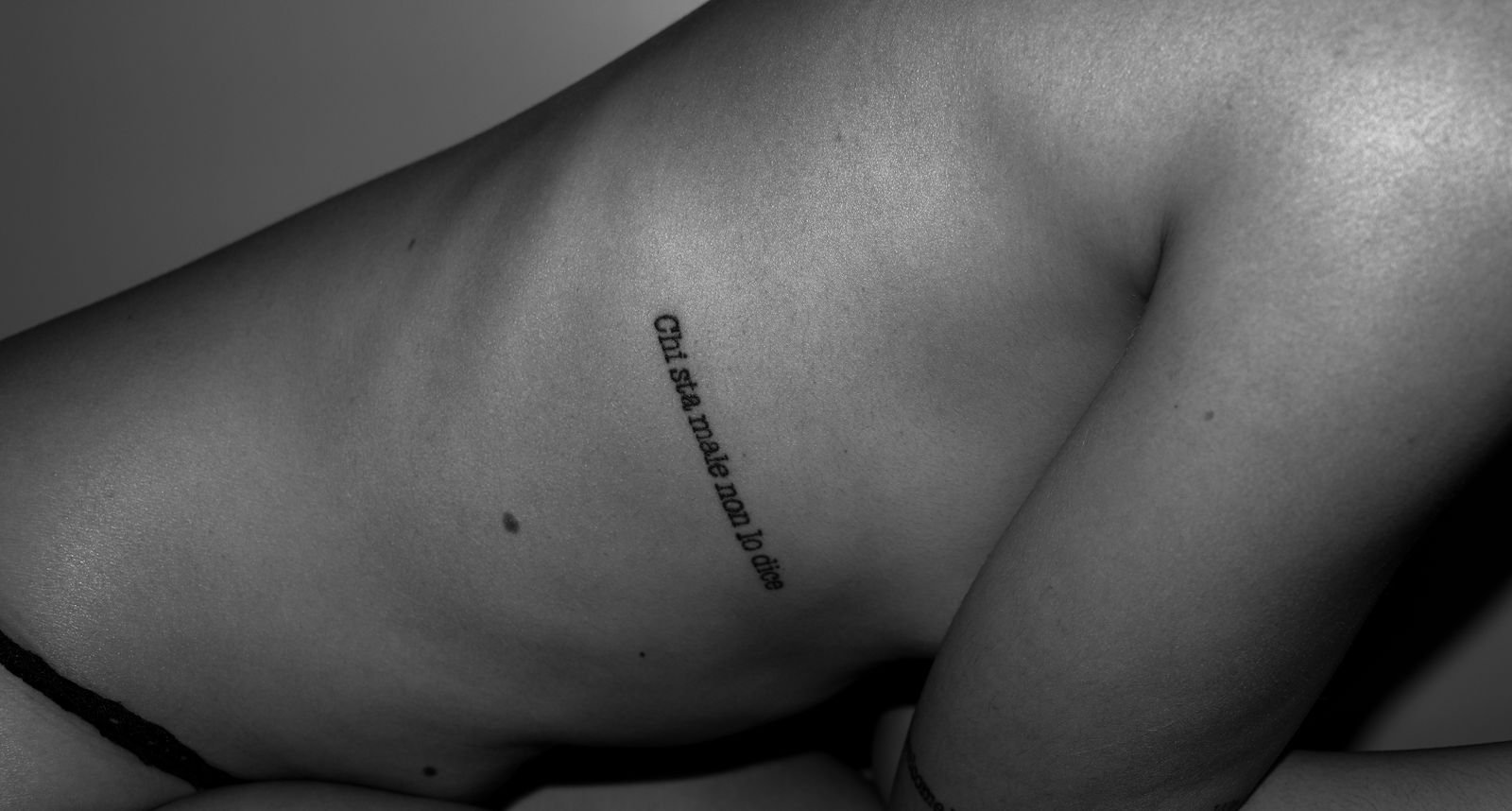
Rib tattoo pain sits in the very high band on our tattoo pain chart — the top of six bands, shared with only four other areas. Bone sits directly under thin skin with almost no fat to absorb the needle, and the whole surface moves every time you breathe. That combination is what separates ribs from merely painful placements.
We do not give ribs a score out of ten, because no published research supports pain numbers for individual body sites. What follows is what makes this placement hurt, how the sensation changes across the ribcage, and what actually reduces it.
Why Rib Tattoos Hurt So Much
Four things stack up on the ribs at once. Most painful placements have one or two of these. Ribs have all four.
| Factor | What happens on the ribs |
|---|---|
| Bone proximity | The ribs sit immediately beneath the skin. Needle vibration transfers straight into bone rather than being absorbed by tissue. |
| Almost no cushioning | There is very little fat or muscle over the ribcage on most people, so nothing dampens the impact. |
| Thin, mobile skin | Rib skin is thin and stretches over a curved surface, which makes it harder to hold taut and more sensitive to each pass. |
| Constant movement | Your ribcage expands with every breath. Unlike an arm, you cannot hold the area still, so the needle meets a moving target for the whole session. |
The breathing element is the one people underestimate. Many describe rib tattooing as a sharp scraping sensation that syncs with the breath, sharpest on the inhale when the ribs push outward against the needle. Shallow, controlled breathing helps, but you cannot stop breathing, which is why rib sessions tend to be shorter than the same design would need elsewhere.
Rib Pain Is Not Uniform: Where It Is Worst
“Ribs” covers a lot of ground, and the sensation changes noticeably across it. Our chart assigns the ribs a single very high band, but within that area the experience varies:
| Area of the ribcage | Relative to the rest of the ribs | Why |
|---|---|---|
| Lower ribs / floating ribs | Often the most intense | The least tissue coverage, and the ribs here are more mobile and less anchored. |
| Side ribs (under the armpit) | Very intense | Thin skin plus proximity to the nerve-dense armpit area. |
| Front ribs, toward the sternum | Intense, sharper quality | Bone becomes broader and flatter as it nears the breastbone. |
| Upper ribs, toward the chest | Usually the most tolerable part | More muscle coverage from the pectoral area starts to cushion the needle. |
If you want rib placement but are worried about the intensity, moving a design upward and slightly forward, toward the upper ribs, is the single most effective adjustment. Your artist can usually shift a composition several inches without changing its shape.
Ribs vs Sternum vs Spine: How the Three Compare
These three torso placements get compared constantly, and they hurt for overlapping but different reasons. All three are bone-over-thin-skin placements, but only two share the breathing problem.
| Comparison | Ribs | Sternum | Spine |
|---|---|---|---|
| Pain band | Very high | Very high | High |
| Main driver | Bone plus constant movement from breathing | Bone directly under skin, nowhere to brace | Vertebrae plus a dense nerve pathway |
| Moves as you breathe | Yes, significantly | Yes, less than the ribs | Barely |
| Distinct sensation | Sharp scraping that syncs with the breath | Deep, dull, resonant ache through the chest | Sharp with occasional radiating jolts |
| Typical session length | Shorter; often split | Shorter; often split | Can run longer with breaks |
| Full guide | This page | Sternum tattoo guide | Spine tattoo pain |
People who have had two of the three often describe the difference in quality rather than amount: the sternum is a deeper, more resonant ache, while ribs are sharper and more surface-level but relentless because of the breathing. The collarbone, one band lower at high, is the usual comparison point for people who want a bony torso placement that is a step less demanding.
What Actually Reduces Rib Tattoo Pain
The largest peer-reviewed survey of tattoo pain, Witkoś and Hartman-Petrycka (2020), surveyed 1,092 people and found that body region did not significantly predict overall pain intensity — but session duration did. That is the most useful finding available for a rib tattoo, because it points at the one variable you fully control.
- Book a shorter session, or split the piece. This is the highest-leverage change you can make. Two three-hour sittings will be remembered as far more manageable than one six-hour sitting.
- Eat properly beforehand. A full meal an hour or two before helps you hold out longer before pain tolerance drops.
- Schedule for the morning. Most people tolerate pain better when rested rather than at the end of a working day.
- Breathe steadily, not shallowly. Holding your breath makes the ribcage rigid and tends to increase the sharpness. Slow, even breathing gives the artist a predictable rhythm.
- Ask for breaks before you need them. On ribs specifically, waiting until you are struggling usually means the rest of the session is worse.
- Avoid alcohol the night before. It thins the blood, which makes the tattoo harder to complete cleanly and can extend the session.
Numbing cream is a common question. It can help through the first part of a session, but coverage is uneven and it wears off, which some people find makes the back half feel worse by contrast. Discuss it with your artist before the appointment rather than turning up with it applied, since some artists decline to work over it.
Is a Rib Tattoo Worth the Pain?
That depends on why you want the placement. Ribs offer a large, private, naturally curved canvas that suits long vertical or flowing designs, and it stays covered in almost any clothing. Those are real advantages that no low-pain placement matches.
But if the appeal is mainly aesthetic and the design would work elsewhere, it is worth knowing that ribs are the placement people most often say they would not repeat. If this is your first tattoo, a placement from the least painful tattoo spots or the forearm is the more common starting point — the outer thigh and outer upper arm sit four bands lower. If you have sat through a long session before and know your tolerance, ribs are far more predictable.
After the Session: What Comes Next
Rib pain does not end when the machine stops. The area stays tender for several days in a way that arm and leg tattoos usually do not, because everything you do — laughing, coughing, twisting, reaching — moves it. Sleeping is the specific problem most people run into, since rolling onto a fresh rib tattoo is easy to do unconsciously.
That is a separate subject with its own practical fixes, and we cover it in full in our guide to rib tattoo sleeping positions, which deals with pillow arrangement, bedding, clothing, and what to do if the tattoo sticks to your sheets. This page is about the session itself; that one is about the two weeks after it.
Frequently Asked Questions
How bad is rib tattoo pain compared to other placements?
Ribs sit in the very high band on our tattoo pain chart, the highest of six bands, alongside the sternum, armpit, hands and face. That places them above high-band areas like the spine, collarbone and ankle, and several bands above cushioned placements such as the outer thigh or outer upper arm.
What does a rib tattoo actually feel like?
Most people describe a sharp scraping or burning sensation directly on bone, which intensifies on the inhale as the ribcage expands. It is usually reported as more relentless than other placements rather than more shocking, because the movement of breathing means there is no still moment.
Do rib tattoos hurt more for thinner people?
Generally yes. Less fat over the ribcage means less cushioning between the needle and bone, so the ribs are more prominent and the vibration transfers more directly. This is one of the clearest examples of body composition changing a placement’s difficulty.
How long can most people sit for a rib tattoo?
Shorter than they expect. Many artists cap rib sessions at two to four hours and split larger pieces across appointments. Since session duration is the factor most strongly linked to reported pain in the available research, splitting the work is the most reliable way to make a large rib piece manageable.
Is a rib tattoo a bad choice for a first tattoo?
It is not a good starting point for most people. Without a sense of your own tolerance, a very high band placement makes it hard to judge how long you can realistically sit. Many artists will suggest starting somewhere more forgiving, then returning to ribs once you know what a long session feels like.
Does rib tattoo pain get worse the longer you sit?
Yes, and the research supports this. The 1,092-person survey cited above found session duration significantly predicted reported pain. On ribs the effect is often more noticeable, because the constant movement from breathing gives the area no chance to settle.
The Bottom Line
Rib tattoo pain earns its very high band: bone directly under thin skin, almost no cushioning, and an area that moves with every breath. The intensity is real and worth planning around, but it is also predictable. Book shorter sittings, place the design toward the upper ribs if you can, and go in rested. For how ribs compare with every other placement, see the full tattoo pain chart, or the ranked list of most painful tattoo spots.